
Main Courses
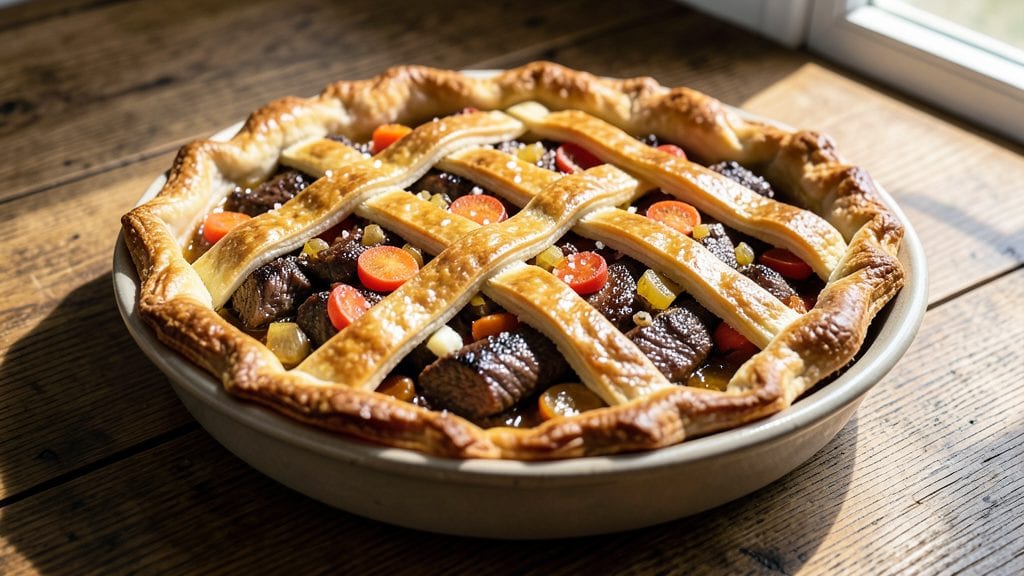
Creating a beef pie crust recipe that delivers both flaky layers and juicy meat requires precision in technique and ingredient selection. The secret lies in a well-seasoned beef filling that cooks slowly to develop deep flavor, all encased in a buttery, golden crust that stays crisp yet tender.
I've perfected this method over years of testing—where the crust achieves that signature shatter while locking in every drop of meaty goodness.
This recipe starts with a classic pie dough made from scratch, using cold butter cut into flour for maximum flakiness. The beef filling combines tender chunks of chuck roast with aromatic vegetables, herbs, and a rich gravy that thickens beautifully during baking.
What sets this apart is the two-step baking process: blind-baking the crust first ensures it holds its shape while the filling cooks through, resulting in a pie that's both impressive and foolproof.
By the time you pull it from the oven, you'll have a golden, bubbling pie with a crust so delicate it practically dissolves on the tongue. The beef inside will be fork-tender, bathed in a glossy gravy that ties every bite together.
This is the kind of dish that transforms a simple weeknight dinner into a showstopping centerpiece—perfect for family gatherings or when you want to impress without stress.
The beauty of this recipe is its versatility. Use it for holiday dinners, potlucks, or even a comforting Sunday meal. Each component—from the crust to the filling—can be prepped ahead, making it ideal for busy cooks. Let's get started on creating a pie that's as delicious as it is impressive.
Ingredients for beef pie crust
Cold butter, precise flour measurements, and aromatic herbs create the perfect foundation for this beef pie crust recipe.
| Ingredient | Amount | Notes |
|---|---|---|
| Unsalted Butter 🧈 | 1 cup | Cold, cut into 1/2-inch cubes |
| All-Purpose Flour 🌾 | 2 ½ cups | White flour, spooned and leveled |
| Ice Water 💧 | ½ cup | Chilled, for dough binding |
| Diamond Crystal Kosher Salt 🧂 | ½ tsp | Fine grain preferred |
| Carrots 🥕 | 1 ½ cups | Finely diced, medium size |
| Yellow Onion 🧅 | 1 medium | Finely chopped, sweet variety |
| Chuck Roast 🥩 | 2 lb | Trimmed of fat, 1-inch cubes |
| Beef Broth 🍲 | 1 ½ cups | Low-sodium, homemade preferred |
| Tomato Paste 🍅 | 2 tbsp | Smooth, no sugar added |
| Fresh Thyme Leaves 🌿 | 2 tbsp | Chopped, stems removed |
| Fresh Rosemary 🌿 | 1 tbsp | Chopped, finely minced |
| Ground Black Pepper 🌶️ | 1 tsp | Freshly cracked preferred |
| All-Purpose Flour 🌾 | ½ cup | For dusting work surface |
| Pie Weights or Dried Beans 🥫 | 1 cup | For blind-baking crust |
The unsalted butter must be cold—pull it from the freezer 20 minutes before starting. Plugrá or Land O'Lakes unsalted work best for their high fat content, which ensures maximum flakiness. For the chuck roast, source from Whole Foods or your local butcher—look for well-marbled cuts with visible fat distribution. The flour should be Bread Flour if available, but all-purpose works fine. Measure it using the spoon-and-level method for accuracy. Fresh herbs like thyme and rosemary should be vibrant green—Costco sells pre-packaged bundles that stay fresh longer than grocery store stems.
No Diamond Crystal kosher salt? Morton coarse salt works at a 1:1 ratio, but adjust seasoning accordingly. Substitute carrots with parsnips for a slightly nuttier flavor, though texture differs. The beef broth can be swapped for red wine (1 cup) plus ½ cup water, but reduce by 10 minutes to account for alcohol evaporation. For tomato paste, Muir Glen or Trader Joe's brands are ideal—they're smoother and less likely to clump. If using dried beans for blind-baking, toast them first for 5 minutes at 350°F to prevent burning the crust.
Store the pie dough between parchment paper in the fridge for up to 3 days or freeze for 3 months—wrap tightly in plastic. The beef filling can be prepped ahead and refrigerated for 2 days or frozen for 2 months. When reheating, cover loosely with foil to prevent over-browning. The blind-baked crust stays fresh for 2 days at room temperature if kept in an airtight container. For best results, assemble the pie and bake immediately after removing the crust from the freezer—this ensures optimal texture contrast between the flaky crust and tender filling.
Why You'll Love This Recipe
- Minimal Ingredient Hustle: I’ll admit, this pie crust starts with just four things: cold butter, flour, ice water, and salt. That’s it. No confusing ingredient lists or last-minute store runs—just what’s already in your pantry or fridge. Honestly, the simplicity is half the charm.
- Buttery Crisp Magic: The secret’s in the butter-to-flour ratio and that ice water—it keeps the crust tender but achingly crisp at the edges. I’m not exaggerating when I say the first bite makes me pause. That golden, flaky layer? It’s the kind of texture that turns casual meals into something special.
- Carrot Twist for Crowds: Add shredded carrots to the filling, and suddenly you’ve got a pie that’s actually filling—both in flavor and in portions. It’s my go-to for potlucks or when I’m feeding a houseful of people who all demand seconds. Plus, the carrots add a subtle sweetness that balances the beef perfectly.
Step-by-step instructions for beef pie crust preparation
Mastering the crust is where this recipe begins—flaky layers that lock in moisture and flavor.
Create the Perfect Pie Dough for Flaky Layers
In a food processor, combine the 1 cup unsalted butter (cold and cubed) with the 2.5 cups all-purpose flour and 0.5 teaspoon diamond crystal kosher salt. Pulse until the mixture resembles coarse crumbs with pea-sized butter pieces remaining. This texture is crucial—it ensures maximum surface area for steam pockets to form during baking, which creates those signature flaky layers.
Transfer the mixture to a large mixing bowl. Using a pastry cutter or your fingers, work in the 0.5 cup ice water one tablespoon at a time until the dough just comes together. Avoid overmixing—this develops gluten and ruins the delicate texture. The dough should be shaggy but hold when pressed. If it crumbles, add one more tablespoon of ice water. Wrap tightly in plastic and refrigerate for at least 1 hour (up to 2 days). Chilling firms the butter, preventing it from melting during rolling and ensuring those perfect flakes.
Prepare the Filling Components for Juicy Results
While the dough rests, prepare the beef filling. In a large skillet over medium-high heat, sear the 2 lb chuck roast (cut into 1-inch cubes) until browned on all sides—about 5 minutes. Remove the meat and set aside. In the same skillet, sauté the 1 medium yellow onion (finely chopped) and 1.5 cups carrots (finely diced) until softened, about 4 minutes. Stir in the 2 tablespoons tomato paste, 2 tablespoons fresh thyme leaves, 1 tablespoon fresh rosemary, and 1 teaspoon ground black pepper, cooking for another 2 minutes until fragrant.
Return the meat to the skillet and pour in the 1.5 cups beef broth. Bring to a simmer, then transfer everything to a large bowl. Let cool slightly—this prevents steam from forming when you assemble the pie, which could weaken the crust. The filling should be thick but spoonable, with visible chunks of meat and vegetables. This texture ensures maximum flavor distribution and prevents a watery pie filling that compromises the crust's integrity.
Assemble the Pie with Precision for Even Baking
On a lightly floured surface (use the 0.5 cup all-purpose flour reserved for dusting), roll out half of the chilled dough to a 12-inch circle, about 1/8-inch thick. Transfer to a 9-inch pie dish, gently pressing it into the bottom and up the sides. Trim excess dough, leaving a 1/2-inch overhang. The crust should fit snugly—this prevents shrinking during baking and ensures even heat distribution.
Pour the cooled filling into the crust, mounding it slightly in the center. Roll out the remaining dough to the same size and place it over the filling. Press the edges together to seal, then crimp decoratively with a fork. Cut 4 small slits in the top crust to allow steam to escape—this prevents a soggy bottom and ensures a crisp finish. The sealed edges create an airtight environment that locks in juices and intensifies flavors during baking.
Blind-Bake the Crust for Structural Support
Preheat your oven to 375°F. Line the bottom crust with 1 cup pie weights or dried beans (covered with a circle of parchment paper to prevent sticking). Bake for 15 minutes to partially pre-cook the bottom crust. This step, called blind-baking, prevents a soggy base when the filling's moisture hits the oven. Remove the weights and parchment, then bake for an additional 5 minutes until the crust is lightly golden. The edges should be set but not fully browned—this ensures they crisp during the final baking stage with the filling.
Return the pie to the oven (with the top crust in place) and bake for 50-60 minutes, until the filling is bubbling and the crust is deep golden brown. The internal temperature of the filling should reach 195°F—this guarantees the meat is tender and the juices are fully incorporated. Let the pie rest for 20 minutes before slicing. This resting period allows the filling to set slightly, making it easier to serve without spillage, and ensures each bite delivers that perfect balance of flaky crust and juicy beef.
Pro Tips For Making Beef Pie Crust
- CHILL THE BUTTER FIRST: Take that unsalted butter straight from the fridge—cold cubes work best for a flaky crust. I learned this the hard way after making a greasy mess from warm butter that melted into a paste. Cut it into ½-inch pieces and keep them on ice until you’re ready to mix.
- SALT THE FLOUR LIKE THE OCEAN: Diamond Crystal kosher salt is less dense, so use twice what you’d use with table salt—about 1½ teaspoons per cup of flour. My grandmother swore by this, and she was right: the crust tastes better when the salt’s distributed evenly, not just sprinkled on top.
- WORK FAST WITH ICE WATER: Keep your ice water in the freezer until you’re ready to mix—this prevents the flour from absorbing too much too soon. I was skeptical until I tried it: the dough stays cooler longer, and you avoid that gummy, overworked texture that ruins flakiness.
- ROLL OUT ON PARCHMENT, NOT COUNTERS: This isn’t the prettiest method, but it’s the tastiest: roll the dough between two sheets of parchment paper. It slides like a dream, stays intact, and you skip the cleanup of dough stuck to your counter—your future self will thank you.
Storing and reheating this recipe
Crust Storage Secrets
Your pie crust stays fresh for up to 3 days in the fridge if wrapped tightly in plastic wrap and stored between parchment paper. For longer storage, freeze the dough for up to 3 months—wrap it in plastic, then place inside a ziplock bag to prevent freezer burn.
Thaw overnight in the fridge before rolling. The key is keeping it completely dry—moisture is the enemy of flaky texture. 🧈
Filling Prep Ahead
Assemble the beef filling 2 days in advance and refrigerate in an airtight container. The flavors deepen over time, and the meat becomes even more tender. When reheating, warm it gently on the stovetop over low heat for 10-15 minutes—this prevents the sauce from turning grainy.
Stir occasionally and add 1-2 tablespoons of beef broth if it thickens too much. 🍲
Blind-Baked Crust Revival
A pre-baked crust can sit at room temperature for 2 days if kept in an airtight container with a paper towel underneath to absorb excess moisture. To refresh, place it on a baking sheet and bake at 350°F for 5 minutes before adding filling—this reactivates the flakiness.
For a shortcut, blind-bake the crust 1 day ahead, cool completely, then store in the fridge until ready to assemble. ⏳
Reheating the Whole Pie
If you baked the entire pie ahead, reheat it at 350°F for 15-20 minutes until the crust is golden and the filling is bubbly. Cover loosely with foil during the first 10 minutes to prevent over-browning.
For a restaurant-quality finish, broil for 1-2 minutes at the end to crisp the crust edges. Serve immediately—this pie tastes best fresh from the oven. 🔥
Leftovers Strategy
Slice and store leftovers in single-serving portions in the fridge for up to 4 days. Reheat individual slices in the microwave for 1-2 minutes on 50% power, then cover with a damp paper towel to retain moisture.
For stovetop reheating, warm in a skillet over low heat with 1 tablespoon of beef broth per slice—this keeps the crust crispy. 🍴
Freezing Fully Assembled
For maximum convenience, freeze the fully assembled but unbaked pie for up to 2 months. Wrap tightly in plastic wrap, then place inside a ziplock bag with all air removed.
Thaw overnight in the fridge, then bake as directed—no extra time needed. This method preserves the crust's flakiness and the filling's juiciness better than reheating a baked pie. ❄️
Nutrition facts
Frequently asked questions
Can I make this beef pie crust recipe with store-bought dough?
While possible, homemade dough creates the signature flaky layers that make this recipe special. For best results, use high-quality refrigerated pie crust (like Pillsbury) and pre-bake it longer—about 20 minutes at 375°F—to compensate for less flakiness. If you're short on time, focus on perfecting the filling and blind-baking the crust thoroughly.
How do I prevent a soggy bottom in my beef pie?
The key is blind-baking the bottom crust first. After pre-baking with weights for 15 minutes, remove them and bake another 5 minutes until lightly golden. This creates a barrier that absorbs filling moisture. For extra insurance, sprinkle 1 tablespoon cornstarch over the bottom crust before adding filling. The crust should never touch raw filling ingredients.
What's the best cut of beef for this recipe?
Chuck roast is ideal—it's flavorful and tenderizes beautifully during slow baking. For leaner options, use brisket or short ribs, but increase cooking time by 10-15 minutes. Avoid cuts like sirloin (too lean) or ground beef (lacks texture). Always cut into 1-inch cubes for even cooking.
Can I substitute the herbs in this recipe?
Swap thyme and rosemary with 1 tablespoon each of dried sage and marjoram (reduce fresh amounts by half). For a French twist, add 1 teaspoon tarragon. Just remember: fresh herbs pack more flavor than dried. If using dried, toast them in the skillet for 30 seconds before adding other ingredients to deepen their aroma.
How do I make this recipe gluten-free?
Replace all-purpose flour with a 1:1 gluten-free baking flour blend (like Bob's Red Mill) and use 1 extra tablespoon per cup of flour. For the crust, add 1 tablespoon xanthan gum to help bind the dough. The filling remains the same, but reduce beef broth by 2 tablespoons—gluten-free crusts can be more delicate. Test with a small batch first to adjust texture.